Stage Notes: Conquering the Las Médulas Special
Red dust coats everything. It clogs the air filters, covers the visors, and stains the skin of every mechanic in the service park. The Las Médulas Special is notorious for breaking cars and crushing spirits. Drivers fear the jagged rocks hidden beneath fine gravel, while engineers lose sleep over suspension setups.
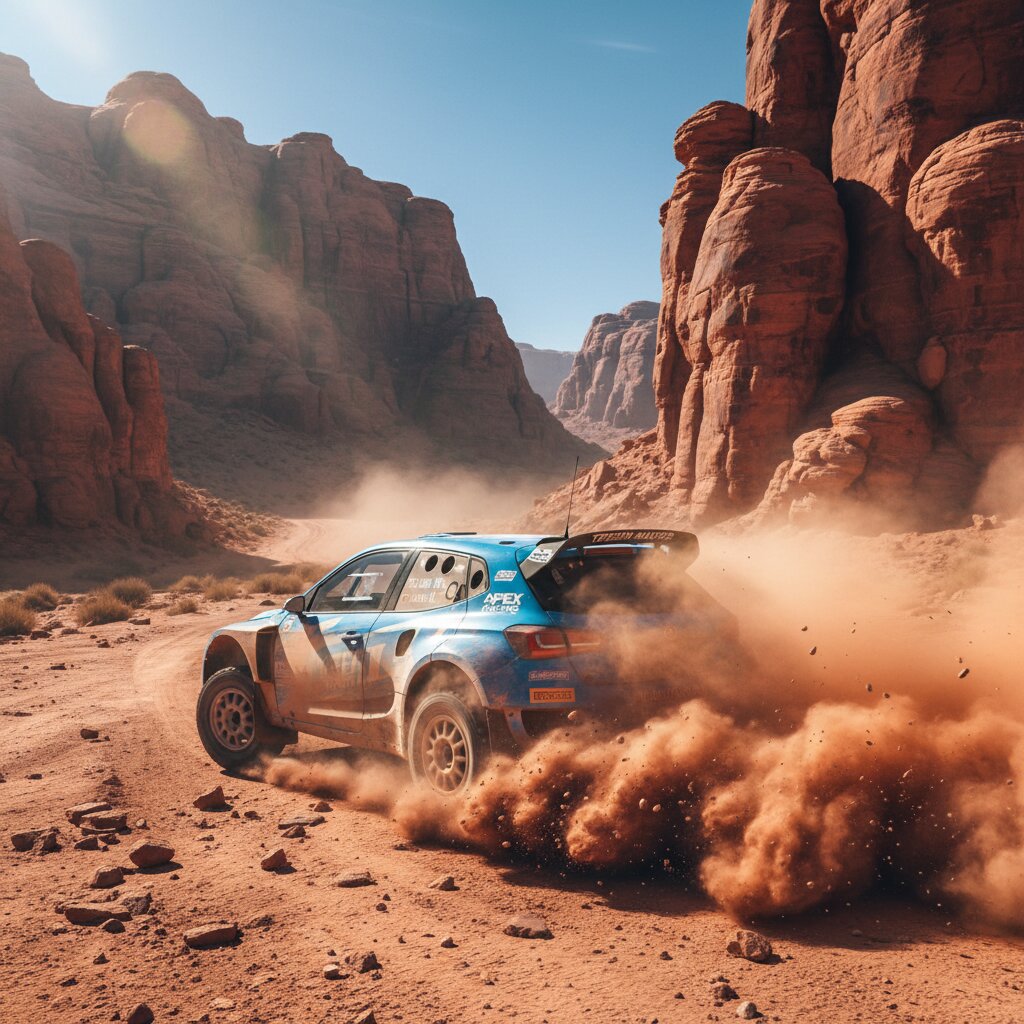
We knew arriving at this ancient Roman gold mining site required a flawless strategy. The landscape resembles Mars, with towering red monoliths and sheer drops that punish the slightest miscalculation. Surviving the twenty kilometers of punishing terrain is a massive achievement. Winning the stage requires absolute perfection.
This race report opens our garage doors to reveal exactly how we secured the fastest time of the weekend. You will see the telemetry data interpretations, hear the driver feedback, and understand the precise mechanical adjustments that kept our car glued to the loose gravel when everyone else slid wide.
A Landscape Forged by Water and Ruin
Centuries ago, the Romans tore this mountain apart using water pressure to extract gold. They left behind a labyrinth of narrow paths, jagged ravines, and abrasive red dirt. As a rally stage, the route presents a brutal combination of high-speed sections suddenly plunging into hairpin turns bordered by unyielding rock faces.
The surface is highly deceptive. A top layer of fine, slippery dust sits over hard-packed clay and sharp stones. Grip levels change constantly. When the midday sun bakes the track, the dust hangs in the air like a thick orange fog, severely limiting visibility for anyone running further down the starting order.
Our Step-by-Step Approach to the Stage
Preparation began weeks before we even unloaded the trailer. We mapped out the entire route using onboard footage from previous years, highlighting every compression, crest, and braking zone.
We divided the stage into three distinct sectors. Sector One demanded aggressive acceleration through sweeping bends. Sector Two featured the tightest hairpins and the steepest climbs. Sector Three was a high-speed descent where fading brakes usually cost competitors precious seconds. By isolating these sectors, we customized our setup to balance the conflicting demands of the course.
Technical Decisions in the Service Park
Suspension Setup
We needed a setup soft enough to absorb the harsh impacts of exposed bedrock, yet stiff enough to prevent body roll during the high-speed transitions. We raised the ride height by ten millimeters compared to our standard gravel specification. We also adjusted the rebound damping to ensure the tires maintained contact with the ground over the endless series of sharp crests.
Tire Choice
Selecting the right rubber was our biggest debate. The abrasive rocks shred soft compounds, but hard compounds struggle to find traction in the loose dust. We gambled on a medium compound with reinforced sidewalls to prevent punctures. We also cut additional transverse grooves into the tread block to help clear the thick red dirt.
Gearing and Braking
We opted for a short-ratio gearbox. Top speed matters less here than punchy acceleration out of the tight corners. For the brakes, we installed our most aggressive carbon-ceramic pads. The constant downhill braking in the final sector generates immense heat, and we needed zero brake fade when approaching the final cliffside hairpins.
Driver Strategy and Pace Notes Adjustments
Our driver and co-driver spent hours refining their notes during the reconnaissance runs. They downgraded several corners from flat out to slight lift after spotting massive ruts forming on the racing line.
The strategy was simple: survive the first five kilometers, attack the technical middle sector, and manage the brakes on the descent. The co-driver emphasized precise positioning calls. Entering a corner just ten centimeters too wide meant sliding into the loose marbles on the outside edge and plunging into the scenery.
Navigating the Critical Sections
The most dangerous segment occurs exactly at the midpoint. Known as the Devil Gorge, the track narrows to the width of a single vehicle. On the left sits a solid wall of red clay. On the right, a sheer drop falls away into the valley below.
Our driver had to threshold brake over a blind crest, downshift twice, and pitch the car sideways before the apex even came into view. The suspension bottomed out violently through the compression, sending a shower of sparks and gravel into the air, but the reinforced tires held their line perfectly.
Overcoming Mid-Stage Challenges
The run was far from serene. Three kilometers from the finish, a football-sized rock rolled onto the racing line. The driver flicked the steering wheel to avoid a direct impact, but the rock still clipped the rear right wheel. The telemetry immediately showed a slow puncture.
Instead of stopping to change the tire and losing two minutes, the driver shifted the brake bias to the front and adjusted the differential settings on the steering wheel. He adapted his driving style instantly, using the handbrake to rotate the car and keeping the weight off the deflating right rear tire.
Engineer Insights and Driver Feedback
Back in the command center, we watched the tire pressure drop on our monitors. The tension was suffocating. We immediately radioed the cockpit, instructing the driver to keep the momentum high and avoid sliding the rear end.
When the car finally crossed the flying finish, the driver keyed the microphone. He reported that the steering wheel vibrated violently over those last two kilometers, and the dust was so thick he navigated the final hairpin purely by memory. However, he noted that the suspension changes saved the run, allowing the car to rotate exactly when he needed it to despite the flat tire.
The Winning Margin
We beat our closest rival by fourteen point two seconds. While other teams suffered catastrophic punctures or overheated their brakes on the final descent, our meticulous preparation paid off. Our medium compound tires were completely worn down to the canvas, but they lasted just long enough. The short gear ratios allowed us to pull away from the tight hairpins much faster than the heavier, long-geared cars of the competition.
Building on the Red Dust Victory
Surviving Las Médulas changes a team. It validates the long hours spent staring at data screens and proves that calculated risks bring massive rewards. We learned that reinforcing the tire sidewalls is mandatory for these abrasive surfaces, and that our custom brake cooling ducts perform far better than expected.
We will carry these exact suspension philosophies into the upcoming rough gravel events. The red dust of the mountain might wash off the chassis eventually, but the lessons we extracted from those brutal twenty kilometers will fuel our championship campaign for the rest of the season.